
Millions of students graduate having mastered academic standards, yet many have never created a budget, reviewed a credit report or filed taxes. Schools cannot truly prepare students for successful adulthood while treating practical life skills as optional.
The concern is more than anecdotal. The National Association of Colleges and Employers reports that only 43% of college seniors felt prepared for their future careers, while 46% of employers reported providing remedial workforce-readiness training to recent graduates. The findings suggest a disconnect between academic success and real-world readiness.
Few voices have been louder on this issue than John Hope Bryant, founder of Operation HOPE and author of “Capitalism for All.” Bryant argues that financial education is not an enrichment opportunity but a necessity.
Bryant has also described financial literacy as “the civil rights issue of this generation,” arguing that ownership creates agency and financial knowledge creates opportunity.
A high school diploma should signify that students have acquired the foundational knowledge necessary to navigate adulthood successfully. No student should graduate without understanding budgeting, banking, credit, taxes, workplace communication, and digital literacy.
The argument aligns closely with Maslow’s Hierarchy of Needs. Before individuals can pursue achievement and self-actualization, they must first establish stability and security. Financial literacy, employability and the ability to manage personal resources are foundational life skills that directly support those needs.
Offering practical life skills only through elective courses like Career and Technical Education programs substantially limits access to knowledge every student needs, regardless of career path or postsecondary plans.
This results in many students graduating without ever receiving instruction in personal finance, professional communication, or career readiness.
It is difficult to justify testing students on academic concepts they may never use again while excluding skills they will surely use throughout their lives. If schools can test for academic readiness, they can also assess financial literacy, computer literacy, and professional communication as indicators of readiness for adulthood.
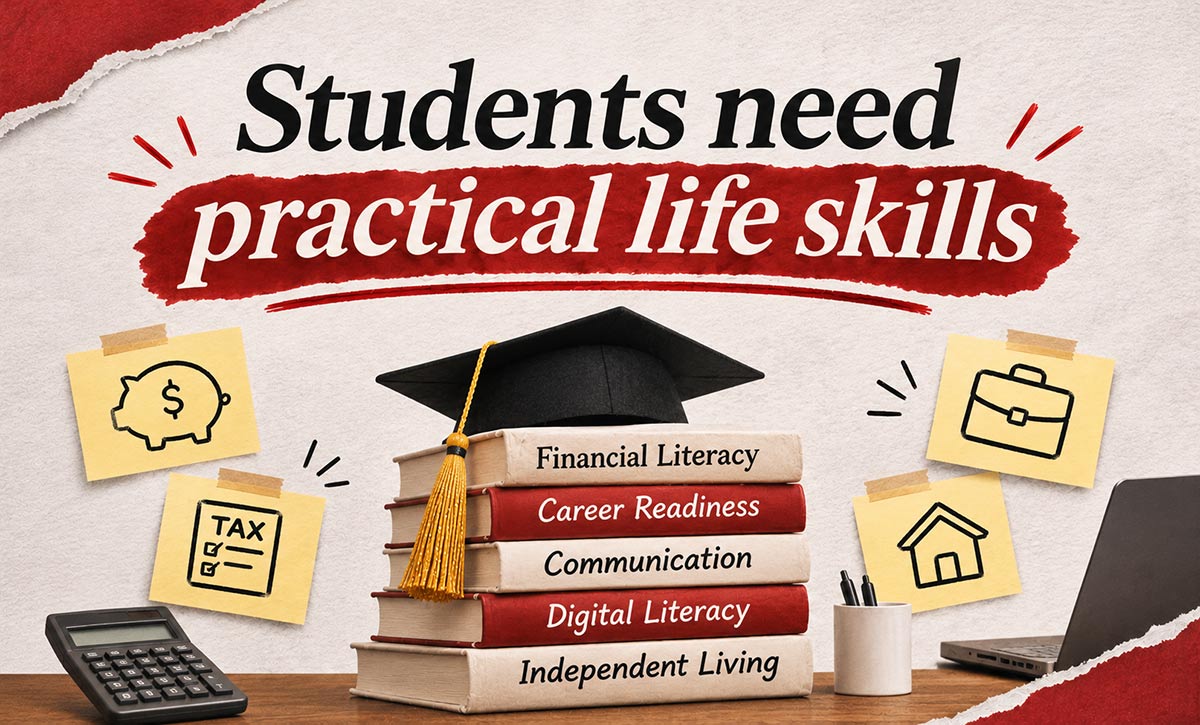
Key practical life skills students need before graduation, including financial literacy, professional communication, and independent living skills.
Community members can help move this conversation forward by attending school board meetings, advocating for personal finance graduation requirements, and encouraging policymakers to expand practical life-skills education.
A diploma should represent more than academic achievement. It should signal that graduates are prepared for adulthood. Practical life skills deserve a place alongside traditional academics.