
Dockens among Top 50 voices in global higher education
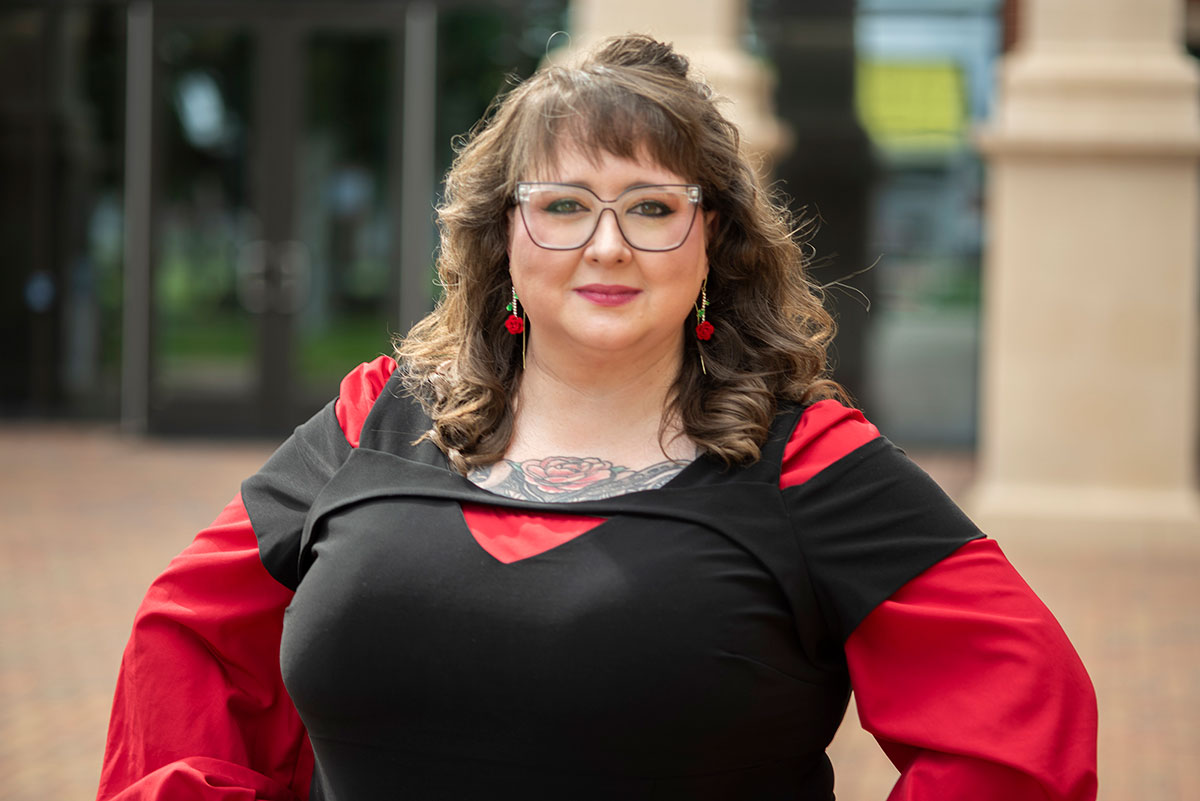
For much of her life, Ashley Dockens never imagined her work would reach beyond the people closest to her. Now, the Lamar University administrator is finding her voice in a global conversation about the future of higher education — one she never expected to be part of.
Ashley Dockens, Lamar University’s associate provost for academic innovation and digital learning, was recently named one of the “2026 Top 50 Voices to Follow in Higher Education,” a global recognition highlighting leaders influencing the future of academics.
Dockens said she was taken by surprise when she received the news.
“I got an email, and I was honest-to-goodness shocked by it,” she said. “You had to be nominated, and I did find out from some of my staff here.”
Dockens said several members of her team at Lamar nominated her for the recognition.
“I kept being like, ‘Are you sure? Are you certain?’” Dockens said.
The recognition was especially meaningful, Dockens said, because of her personal background and her struggles with imposter syndrome.
“I’m a small-town girl from the Appalachian foothills of northeast Alabama, and was first gen in fully getting a degree,” she said.
Dockens said she never expected to have a far-reaching impact in higher education.
“I think all of my life, I never expected myself to do anything, to go anywhere, to be something of major value to anyone, other than maybe my immediate people,” she said.
“I think, for this, it kind of let me pause a second and go, ‘Wait a minute, maybe I’m having more far-reaching effects than I thought I was. And that was a pretty amazing thing.”
The recognition comes as Dockens has gained an international presence in conversations surrounding artificial intelligence and its role in higher education.
“I wasn’t expecting to be a name in higher education around AI,” Dockens said. “But honestly, I think it’s because of the work that I do with AI that I started really getting my face out there and known.”
Dockens credited her colleagues for helping bring attention to her work.
“I have a beautiful, wonderful team of people in the Center for Innovation and Teaching and Learning and in University Innovation,” she said.
International recognition also caused Dockens to reflect on the work being done by others who are overlooked.
“It certainly also led me to realize that a lot of people are sort of hidden in pockets, doing amazing things that people aren’t seeing,” she said. “Sometimes you just need somebody to push that into the light.”
Dockens said her team encouraged her to apply for the associate provost position, meaning she was able to exchange ideas with professionals who specialize in areas outside her own expertise.
“The thing it’s already done, is it’s really put me in connection with a lot of other folks in higher education who are investigating these same things,” she said. “We’ve been able to find folks who do have more specialty, and being able to connect with them and say, ‘Hey, what recommendations do you have for this?’ And that’s been really helpful”
Dockens’ higher profile has increased requests for her to speak about AI and higher education.
“My name is in more mouths than I probably need it to be,” she said. “I’m almost overwhelmed by requests for speaking and what have you.”
However, Dockens said she has become more selective about speaking opportunities so she can also highlight the university.
“I’ve really tried to get a little more choosy and go out there and really promote what Lamar is doing in these spaces,” she said.
Dockens’ work with AI includes Lamar’s “AI in Every Program initiative,” which focuses on preparing students to understand how AI affects their individual fields.
The initiative is not about putting AI into every part of every program, Dockens said, but about making sure students understand what they will need to know about the technology when they graduate.
“I think every student on the entire planet needs to have at least basic AI literacy moving into AI fluency,” she said.
That includes understanding how AI works, what it can be used for and what it should not be used for, while continuing to develop human skills such as discernment, Dockens said.
“AI is the least dangerous when you already have the background knowledge to use it,” she said.
Students need to look beyond their classrooms and pay attention to their professional organizations, job listings and accreditation requirements, Dockens said, to understand how AI is changing their fields.
“If you’re not finding it in your programs, ask those questions,” she said. “Make sure that you’re getting the most out of your education.”
While recognition has been overwhelming, Dockens said it has been an opportunity to continue growing and sharing Lamar’s work.
“It’s been really cool to already make those connections,” she said. “In a way, I was doing a bit of it before, but it definitely ramped it up.”
The small-town Alabama girl is certainly no imposter in the world of AI and academia.
“Maybe I’m putting out things into the world of value, too,” Dockens said.