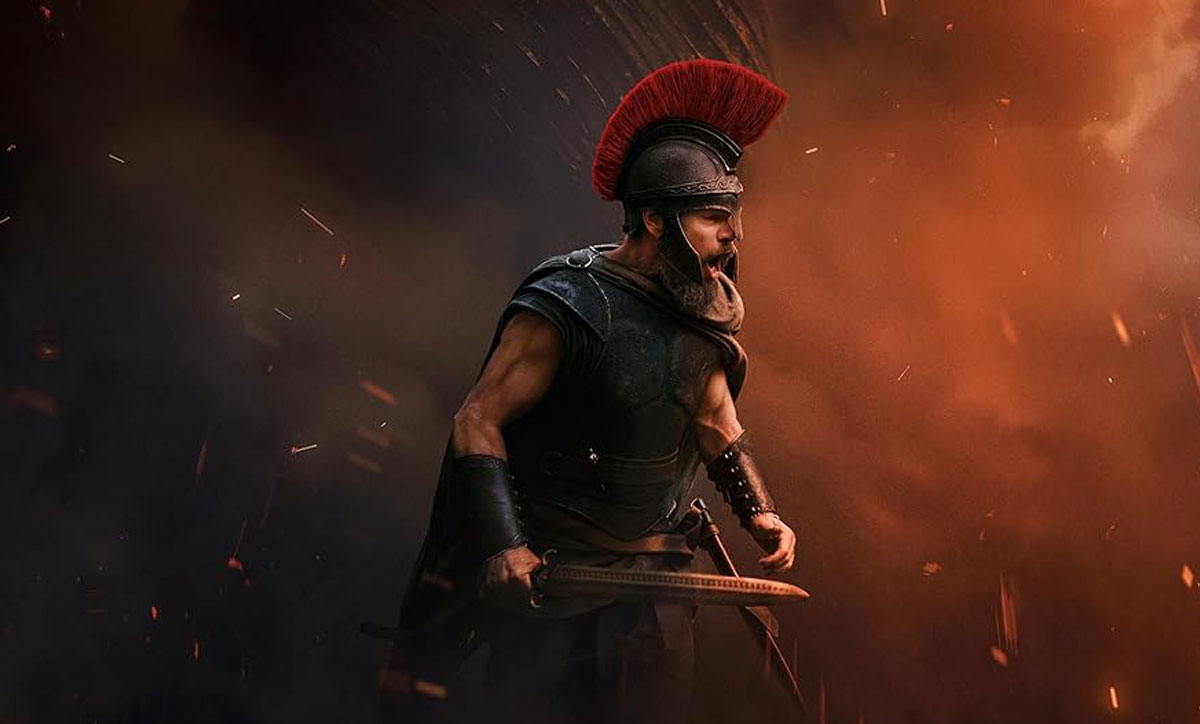
Christopher Nolan’s “The Odyssey” is marketed as the first feature film to be shot entirely with IMAX cameras. Why does that matter?
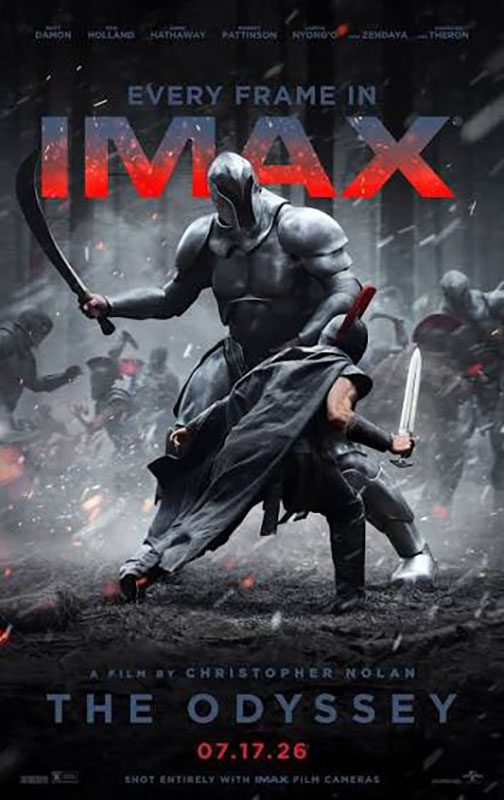
IMAX, short for Image Maximum, is a premium, large format film, designed to make movies seem grander. Large format techniques have been in use since cinema’s inception, but gained popularity with the rise of 70mm film in the 1950s.
With television booming, filmmakers needed to give audiences a reason to buy a ticket. The solution was the widescreen format, especially in epics such as “The 10 Commandments” and “The Robe.”
The terms 65mm and 70mm are terms often used in conjunction with each other — 65mm film is the length of the film’s negative and 70mm film is the length of the film with the additional audio strip. 70mm film is twice as large as traditional 35mm film.
Films like “Lawrence of Arabia” and “2001: A Space Odyssey” popularized the use of 70mm film, specifically the Super Panavision 70mm format. Super Panavision had a sister format, Ultra Panavision 70mm, which created an even wider image that utilized anamorphic lenses to further stretch out the film.
Anamorphic lenses were also utilized for Cinemascope, a format that barely lasted three years, and was projected in the Cinerama format which used three projectors to create a 146-degree field of view. Cinerama’s roots can be seen with the current ScreenX, a viewing experience that allows for a 270-degree field of view.
Ultra Panavision 70mm was projected through normal 70mm projectors, but was only used for nine movies between 1957 and 1966, notably being used to shoot “Ben-Hur.” The format was revived with 2015’s “The Hateful Eight,” and used for the majority of 2025’s “Sinners.” The format was used in combination with a widescreen aspect ratio to capture vast, epic vistas to contrast television’s smaller aspect ratio.
Vistavision was another short-lived format that was primarily used from 1954 to 1961, notably in Alfred Hitchcock's “Vertigo.” While normal 35mm cameras pull the film vertically, Vistavision pulled the film horizontally, creating twice as large an image, roughly equal to 8K digitally.
Vistavision fell into obscurity after 1961, being only used to shoot special effects scenes after that. However, it has recently seen a resurgence with Oscar darlings like “The Brutalist,” “Bugonia” and “One Battle After Another” all utilizing Vistavision cameras.
Traditionally, Vistavision gave an aspect ratio of 1.5:1 which filmmakers cropped to a more traditional widescreen ratio of 1.85:1, with 2025’s “Bugonia” being one of the first to maintain its native aspect ratio.
“Birdman” director Alejandro González Iñáritu’s upcoming film, “Digger,” is being filmed for IMAX theaters but shot on Vistavision cameras.
This all begs the question, since large format isn’t new, what makes IMAX so special?
IMAX was founded in 1967 in Canada originally under the name “Multiscreen” until the founders decided multi-screen projection was impractical and switched over to a single projector large format style.
IMAX cameras work by pulling the 65mm film horizontally, similar to Vistavision. This method gives the IMAX 70mm film 15 perforations instead of the typical five perforations of 70mm, which increases the resolution and quality of the film.
“Tiger Child,” the first IMAX film, was released at an expo in Osaka, Japan in 1970. It wasn’t until 1976 when “To Fly,” a 27-minute long IMAX documentary, was released to the U.S. and Canadian public and shown at the National Air and Space Museum. “To Fly” held the record for the highest grossing documentary until 2004.
IMAX was traditionally utilized for documentary work until Christopher Nolan incorporated IMAX footage in the opening bank heist scene in “The Dark Knight.” Since then, the format has become increasingly sought after for its sharp image and quality.
The cameras work well for loud, action scenes. However, IMAX cameras are incredibly bulky and loud, making them impractical for intimate scenes. So, the filmmakers behind “The Odyssey” worked closely with late IMAX chief quality officer David Keighley on experimenting with a “blimp,” a soundproof box for the camera. The film ended up using a mix of the traditional IMAX camera and a new, quieter camera setup named in Keighley’s honor.
IMAX film captures a massive image equivalent to nearly18K resolution compared to 4K with traditional 35mm film. Nolan’s most recent feature, “Oppenheimer,” even required developing specialized black and white IMAX film.
Nolan’s obsession with premium and large format movies is what makes “The Odyssey” special. Marketing for the film emphasizes the premium format experience.
The movie reviewing and tracking website, Letterboxd, has even added a digital punch card so moviegoers can check off the premium formats they saw the film in, making the innovation more recognizable.
The digital punch card includes traditional 35mm film, 70mm film, IMAX digital projection, IMAX 70mm, Dolby Vision, and premium large format. Examples of premium large format include Cinemark’s XD screens and DBOX experience, Regal’s RPX screens and 4DX experience, as well as the ScreenX experience.
An adaptation of an epic story, shot entirely in a format with a resolution equivalent to 18K, is something that large format film has been reaching for since its inception — a celebration of epic filmmaking.
Oftentimes, what gets praised as innovative isn’t necessarily a new idea, but rather the synthesis of several ideas others have tried before. “The Odyssey” is the culmination of a century of filmmaking craft.
If the movie has the same quality as the film it is shot on, it will be something worth seeing.