
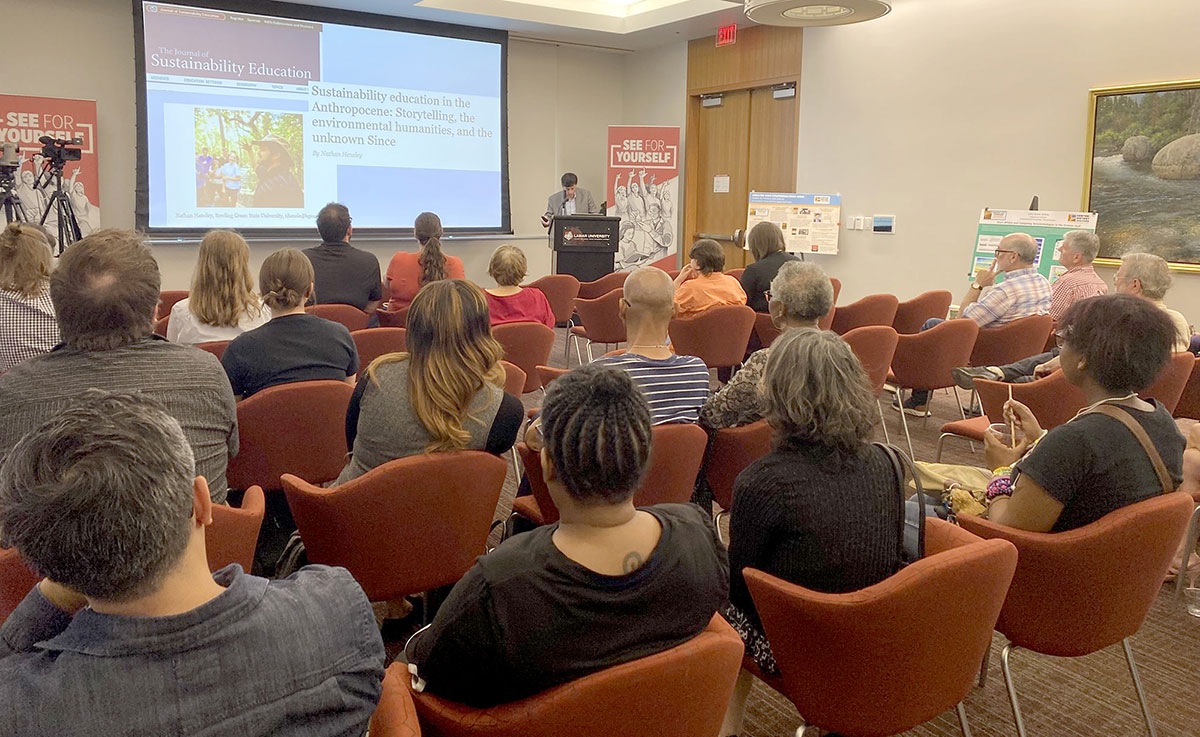
The Gulf Coast area is rich with stories of its diverse peoples and their histories. Writer and folklorist Keagan LeJeune, who delivered the keynote address for the 5th annual Greater Gulf Symposium, said the Gulf Coast’s complexity makes storytelling essential to understanding its culture and environment.
“The Gulf is massive, incredibly diverse,” he said. “It touches so many cultures and people. It was an impossible topic for a keynote address for me and I felt the same way about storytelling as a topic, maybe even more so.”
LeJeune’s speech concluded the symposium, presented by the Center for History and Culture of Southeast Texas and the Upper Gulf Coast, which featured research presentations by Paula R. Buchanan, Paul Del Bosque, Chaney Hill, Cory Diane Ashby, Marquel Sennet and Will Carr, which covered topics as diverse as disaster management, musicology, history, media studies and Mexican American studies.
Lejeune talked about the natural and cultural richness of the Gulf Coast, noting its aquatic diversity and human communities.
“Our Gulf is the world’s largest gulf, the planet’s ninth-largest body of water,” he said. “It has 49 species of shark, and biologists have counted over 300 species of fish — and that’s just off the Texas coast.”
On his personal engagement with storytelling, Lejeune said even a seemingly minor discovery can spark curiosity and connection.
“I really didn’t know about the ‘Hot Tub of Despair’ before a couple of weeks ago, or ‘The Flower Garden,’ or most of these other interesting facts that the internet told me,” Lejeune said. “It made me realize that storytelling is often about exploring the unknown and making sense of it for ourselves and others.”
Lejeune referenced the symposium’s presenters in his talk. He said Paula Buchanan’s work in disaster management emphasizes how narrative can help communities interpret hazards and prepare for emergencies.
“Stories act as a bridge between scientific expertise and community experience,” Lejeune said, “highlighting that storytelling grounds scientific knowledge in local values and lived experience.”
Chaney Hill’s research links storytelling to history and memory, showing how landscapes themselves convey narratives.
“The land participates in the complex, layered storytelling that shapes a region’s identity,” Lejeune said, “describing sites like the Baytown Nature Center and the San Jacinto battlegrounds.”
Paul Del Bosque’s research highlights storytelling’s role in preserving oral histories of hurricanes.
“Historical participants are not just handing over a story,” LeJeune said. “They themselves are the story, illustrating how memory and narrative are inseparable.”
Lejeune discussed the work of Will Carr which emphasizes the media’s role in shaping disaster narratives.
“This work illustrates how narratives possess their own logic that can disengage our intellect and help us down a path,” LeJeune said. “It is a path that is sometimes strange and sometimes dangerous, but it’s often quite unknown, I think, until we’ve traveled down it.”
Lejeune also reflected on storytelling as a tool for cognitive and emotional engagement, noting its neurological impact.
“Stories immerse us, transport us, and reward us with dopamine,” he said.
LeJeune encouraged attendees to embrace uncertainty as part of learning and growth. He said storytelling is not only a record of the past, but also a mechanism for ethical and ecological understanding. Stories shape environmental knowledge and collective thinking.
“We must delve into our own lived experience,” he said. “To do this, we have to have a story.”
Lejeune wrapped up his keynote by connecting storytelling to everyday observation.
“I believe there’s a power in the stories people tell, a power I felt when I heard them as a boy,” he said. “(It’s) the same power I experienced the very first time I went on an official fieldwork trip and visited with a 90-year-old woman who told me stories about a small west Louisiana town’s well-known outlaw.”
For more on the Center for History and Culture of Southeast Texas and the Upper Gulf Coast, visit lamar.edu/arts-sciences/research-centers/ center-for-history-and-culture.