
For the past 25 years, April has been designated as Sexual Assault Awareness Month. However, efforts to raise awareness and advocate against sexual assault happen all year round.
To fully understand the need for these efforts, one must first understand what sexual assault is. According to Columbia Health, “Sexual assault is any type of sexual contact without consent.”
Consent should be given enthusiastically without coercion. Coercion encompasses any threats, insults, humiliation, exploitation of power, or more. For example, if someone tells you that they thought you loved them but no longer believe it because you’ve said no to a sexual act, they are coercing you to change your answer to yes.
While these terms might just seem like just words, it is important to put them into perspective. For college students, sexual assault is a prominent issue.
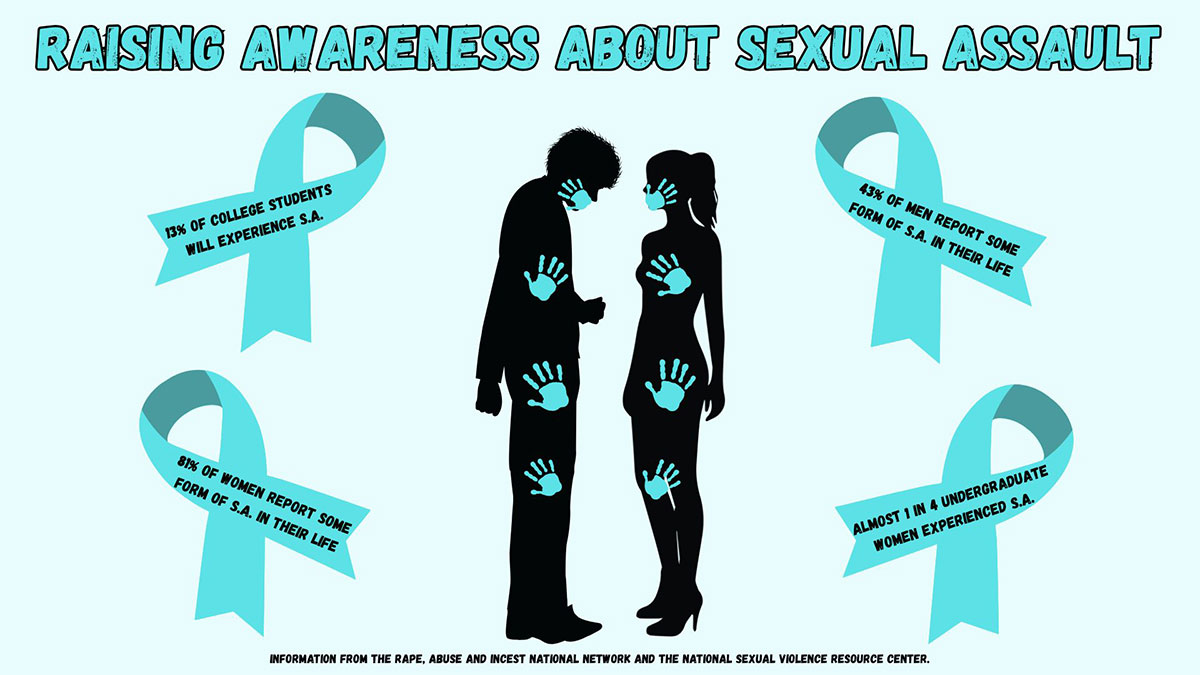
Thirteen percent of all students on college campuses will experience rape or sexual assault, according to the Rape, Abuse and Incest National Network’s article “Statistics: Campus Sexual Violence.” This number only goes up for undergraduate women, with 26.4% experiencing rape and sexual assault involving physical force, violence or incapacitation.
According to the National Sexual Violence Resource Center, “Almost one in four undergraduate women experienced sexual assault or misconduct at 33 of the nation’s major universities.”
Looking at these statistics seems dreary. However, there are ways that we can make a difference.
Incapacitation in college often occurs due to alcohol or drug use prohibiting someone from being in the right mind. It is important we know our limits and stay close to those we trust.
To protect others, we should be the trustworthy one they can keep around. We can keep an eye on our friends and watch for body language differences and social cues. If we see somebody looking visibly uncomfortable as someone speaks to them, keep an eye on the situation.
If we see something concerning, alert others. We should not put ourselves in a dangerous position by getting involved alone, but we should not be a bystander.
It is important that victims of an assault know they are not to blame. They deserves support and there are many avenues to get that support in Southeast Texas.
Students at Lamar University can contact the Title IX office by visiting lamar.edu/titleix, contact LUPD.
If you know someone that has been sexually assaulted, the best thing that one can do is offer support. While it sounds cliche, offering to be somebody they can lean on whenever they feel open to sharing allows them to feel safe.
Understand that someone who has been assaulted might not want to talk about it or even acknowledge it immediately. They might just want to feel normal again, and if that’s their choice, help them to make it. Healing isn’t linear and cannot be tracked, but we can be by their side along the way.
We should advocate for not only those we know, but for anyone who might’ve been affected. If we broaden the statistics to encompass more than college campuses, the numbers are even higher.
According to the NSVRC, “81% of women and 43% of men reported experiencing some form of sexual harassment and/or assault in their lifetime.”
Sexual assault is an issue that demands our attention in order to prevent it. We should use our voices to speak for those who feel silenced by their perpetrators. Their voices need to be heard — not just during April.