
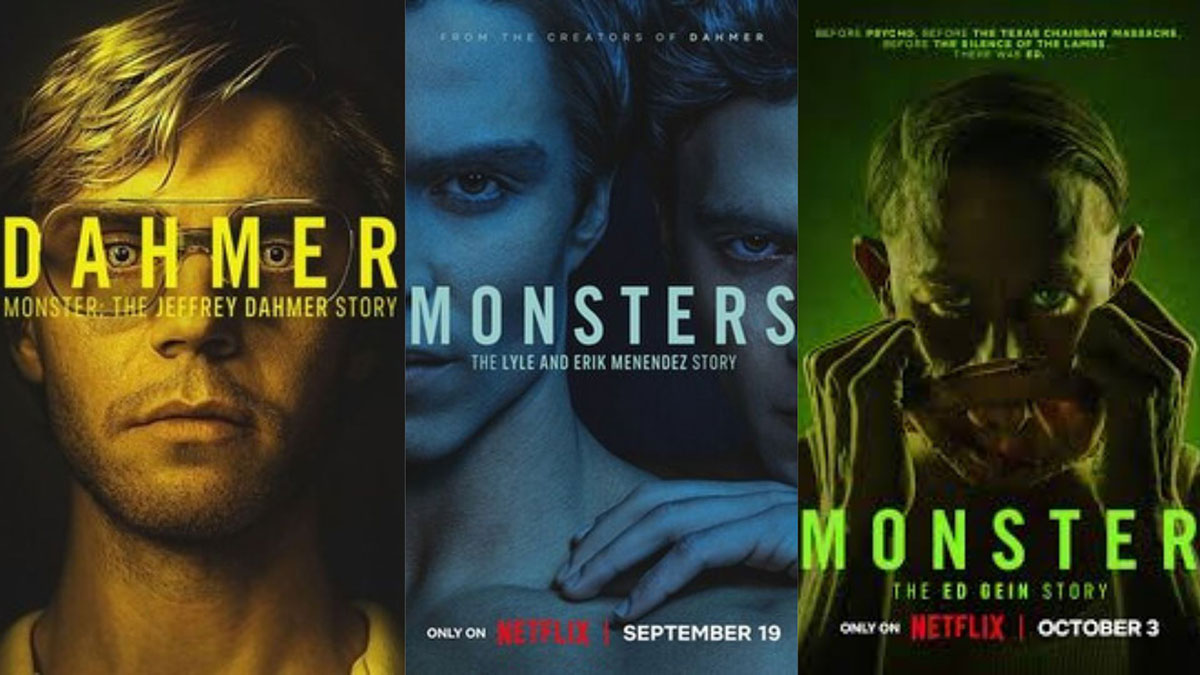
When one hears the term “true crime,” they often expect a documentary or podcast. Grisly details are a given, but one thing is always expected — that the story is true. However, what happens when one watches the story unfold just to realize that it is closer to a horror movie than it is the truth?
Ryan Murphy’s “Monster: The Ed Gein Story” premiered on Netflix Oct. 3, and viewers quickly realized that some of the killings were quite far from reality, despite the show’s advertisement as true crime. This raises the question: is it ethical to fictionalize true crime?

True crime dramatizations center around real people, whether victim or villain. Names stay the same and attempts to match appearance are made. Yet there are times that the story does not stay the same. “Monster: The Ed Gein Story” is just the latest of Murphy’s dramatized true crime anthology, which begins with Jeffrey Dahmer, follows with the Menendez brothers, and now tells Ed Gein’s “story.”
First, imagine your family member went missing around the same time a killer was on the loose but there is no proof that she was murdered. In fact, the only leads in this unsolved case are two men and evidence points toward an abduction, not a killing. This is the story of Evelyn Hartley, a 15-year-old girl who went missing while babysitting in Wisconsin, around the same time grave robber and murderer Ed Gein was active.
The Netflix show fictionalizes the entire story, creating a plot where Gein abducts and murders Evelyn, despite there being no evidence of this in real life. Imagine yourself as Hartley’s family member, watching Evelyn’s story — except it’s not really her story.
Second, Ed Gein, in “real life,” was only tried and found guilty on one count of first-degree murder, although he did confess to one other killing and at least nine instances of grave robbing.
But portraying him as a serial killer without proof is not ethical in the same way changing victims’ stories is not.
Both of these examples in “Monster: The Ed Gein Story” bring up ethical considerations of the true crime genre, exceeding the criticism Murphy received after the release of “Monster: The Jeffrey Dahmer Story” regarding the ethics of using victims’ stories without the family’s consent. Not only were victims’ stories used without consent in the Gein show, but the stories were altered and dramatized with the real victim’s name plastered on.
If a storyline is fictionalized, it goes against the exact definition of the word “true”. So, is it truly ethical or fair to even consider the “Monster” series true crime?
Had Murphy taken the route of Alfred Hitchcock’s “Psycho” or Tobe Hooper’s “The Texas Chain Saw Massacre” and created a horror movie inspired by Gein, the show would not be nearly as unethical. Labeling something as true crime, especially knowing society’s constant hunger for the gruesome details, only leads to misinformation and harm.