
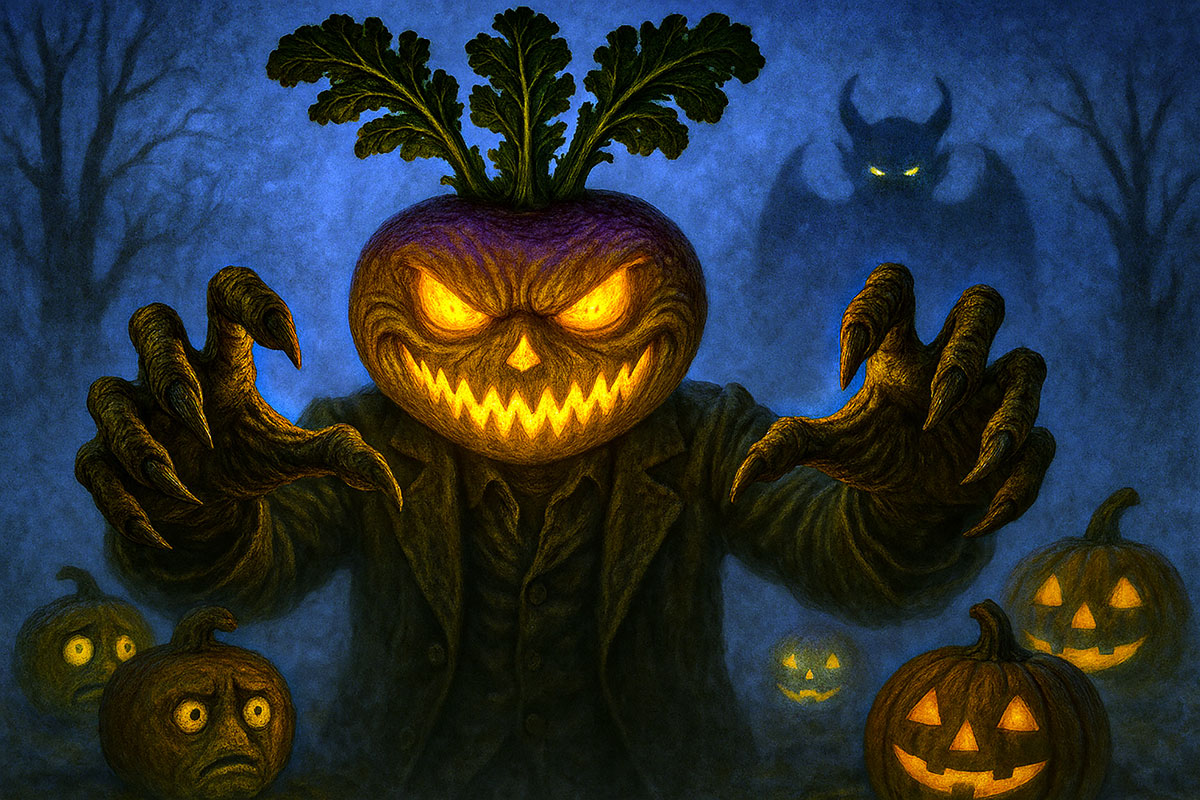
Before yards were decorated with glowing carved out pumpkins for Halloween, turnips were once the face of spooky season, courtesy of the Irish legend of Stingy Jack.
According to early 1600s Irish folklore, Stingy Jack is a shunned, drunken man who resides in a small village in Ireland. Jack was notorious for committing bad deeds, thus piquing the interest of the Devil.
Before Satan claimed Jack’s soul, Jack proposed that the Devil allow him to have one final drink at a pub before he became bound to the underworld.
When it came time to pay for his tab, the Devil realized that Jack was not called Stingy Jack because it had a nice ring to it. Jack convinced the Devil to turn himself into a coin to pay his tab.
However, Jack was as clever as he was stingy.
Instead of paying his tab, Jack put the coin into his pocket next to a crucifix, trapping the Devil, and continued his path of stinginess.
The Devil’s pleas of freedom were ignored until he struck a deal that upon being released, the Devil would not bother Jack for an entire year and that his soul would be spared.
A year went by, and this time, Jack asked the Devil to climb up a tree to pick some fruit. While the Devil was up there, Jack carved a cross into the tree, leaving the Devil unable to climb down unless he promised to leave Jack’s soul alone for 10 years.
Jack passed away shortly after, and due to his devious deeds, God would not allow him to pass through the pearly white gates, and the Devil, bound by his word, would not allow him to enter Hell.
The Devil gifted Jack a piece of coal which he put into a carved turnip and the Devil sent him off to roam around into the night, with only the turnip lantern to light the way.
It is said that Jack has been wandering Earth ever since, with the Irish referring to him as “Jack of the Lantern” then later, “Jack ‘O Lantern.”
To keep this evil wandering spirit away, the people of Ireland and Scotland take inspiration from Jack’s lantern and create their own carved out turnips that they place outside their windows to ward off Stingy Jack and whatever spooky souls that follow during Samhain, a pagan festival that is celebrated from Oct. 1 through Nov. 1. The festival welcomes in the harvest and invites the dark half of the year in.
When the Irish immigrated to America due to the Great Potato Famine in the 1840s, they found that pumpkins were more abundant and easier to carve, thus creating a Halloween tradition of pumpkin carving that is still popular today.
Although it has been centuries since Jack’s carved turnip of coal illuminated the dark night, his legacy burns bright, gourding — I mean, guarding — people’s home throughout Halloween’s fright.