
HOUSTON — “You could describe the art world as a party at my dad’s house,” Christopher Rauschenberg said, recalling his father Robert’s boundless energy and curiosity.
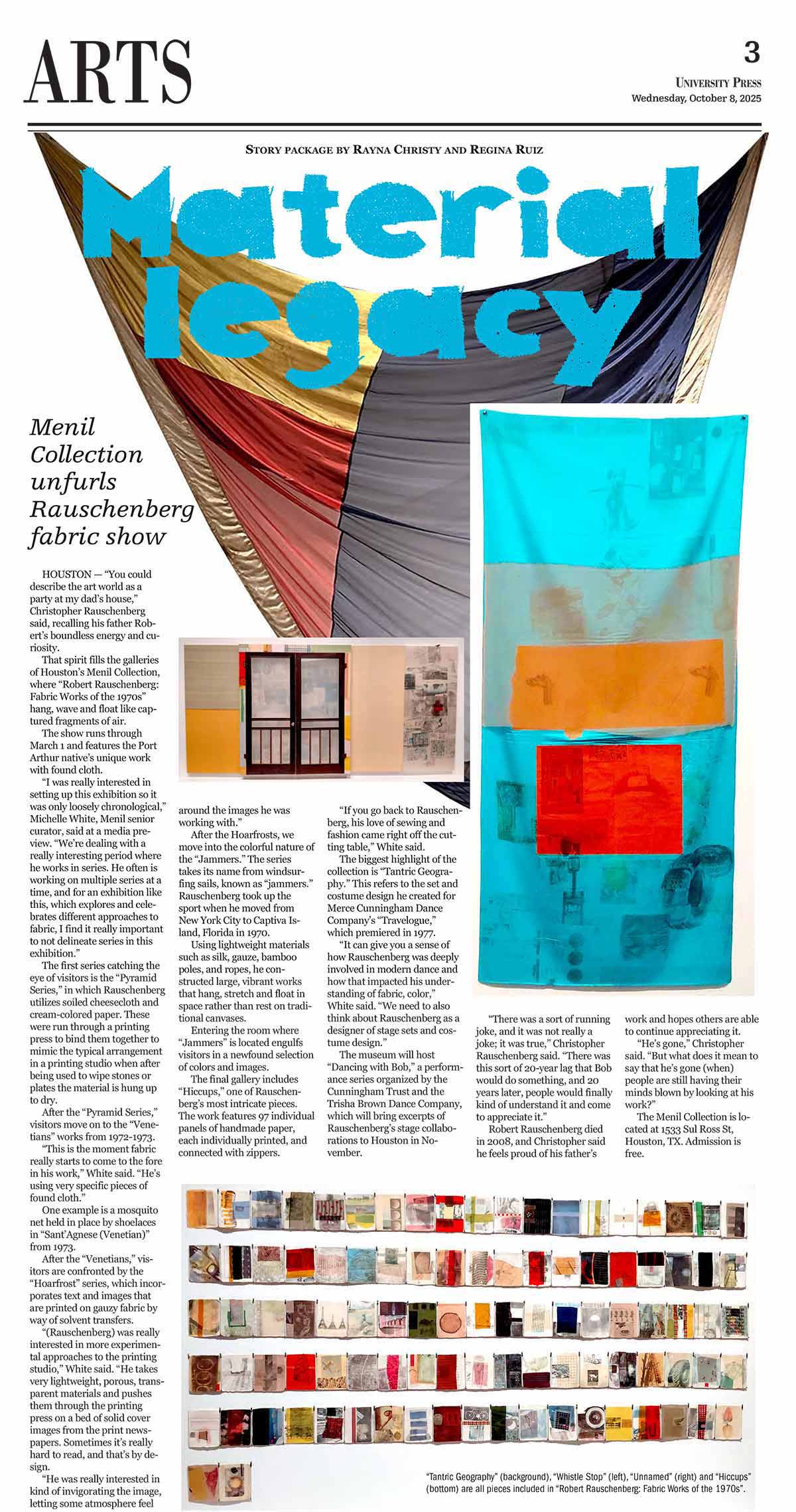
That spirit fills the galleries of Houston’s Menil Collection, where “Robert Rauschenberg: Fabric Works of the 1970s” hang, wave and float like captured fragments of air.
The show runs through March 1 and features the Port Arthur native’s unique work with found cloth.
“I was really interested in setting up this exhibition so it was only loosely chronological,” Michelle White, Menil senior curator, said at a media preview. “We’re dealing with a really interesting period where he works in series. He often is working on multiple series at a time, and for an exhibition like this, which explores and celebrates different approaches to fabric, I find it really important to not delineate series in this exhibition.”
The first series catching the eye of visitors is the “Pyramid Series,” in which Rauschenberg utilizes soiled cheesecloth and cream-colored paper. These were run through a printing press to bind them together to mimic the typical arrangement in a printing studio when after being used to wipe stones or plates the material is hung up to dry.
After the “Pyramid Series,” visitors move on to the “Venetians” works from 1972-1973.
“This is the moment fabric really starts to come to the fore in his work,” White said. “He’s using very specific pieces of found cloth.”

One example is a mosquito net held in place by shoelaces in “Sant’Agnese (Venetian)” from 1973.
After the “Venetians,” visitors are confronted by the “Hoarfrost” series, which incorporates text and images that are printed on gauzy fabric by way of solvent transfers.
“(Rauschenberg) was really interested in more experimental approaches to the printing studio,” White said. “He takes very lightweight, porous, transparent materials and pushes them through the printing press on a bed of solid cover images from the print newspapers. Sometimes it’s really hard to read, and that’s by design.
“He was really interested in kind of invigorating the image, letting some atmosphere feel around the images he was working with.”
After the Hoarfrosts, we move into the colorful nature of the “Jammers.” The series takes its name from windsurfing sails, known as “jammers.” Rauschenberg took up the sport when he moved from New York City to Captiva Island, Florida in 1970.
Using lightweight materials such as silk, gauze, bamboo poles, and ropes, he constructed large, vibrant works that hang, stretch and float in space rather than rest on traditional canvases.
Entering the room where “Jammers” is located engulfs visitors in a newfound selection of colors and images.
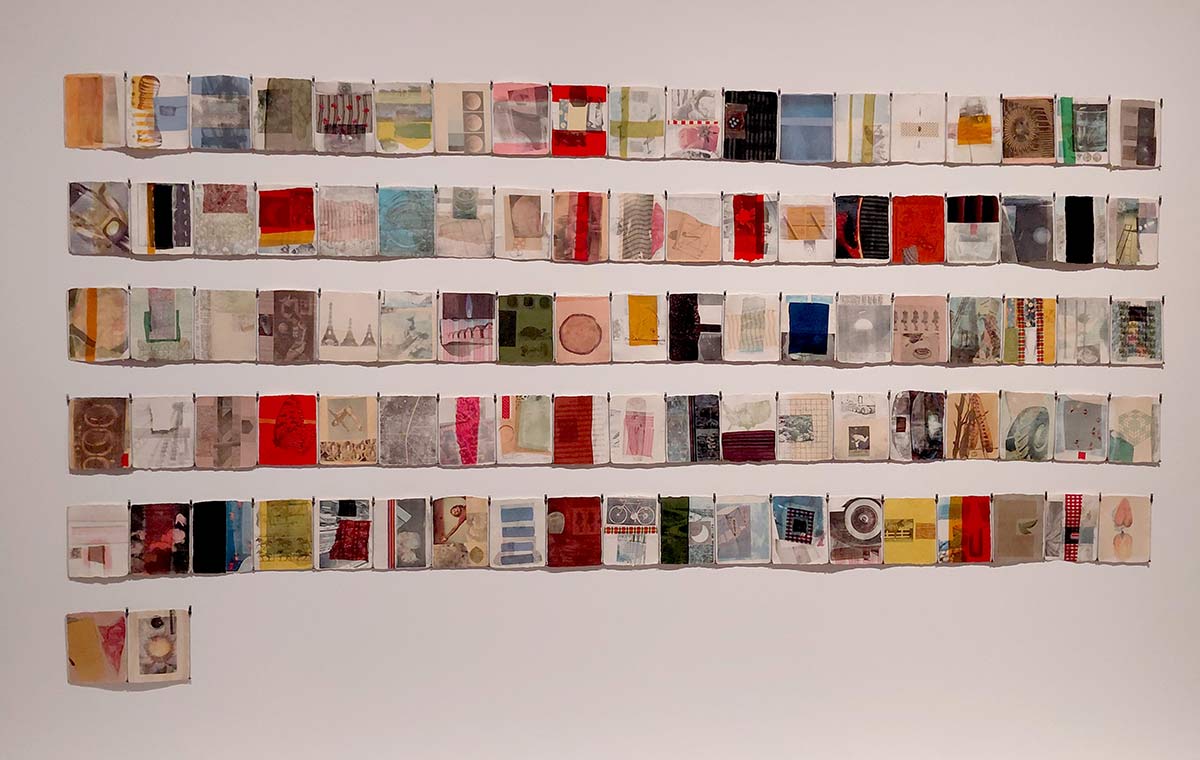
The final gallery includes “Hiccups,” one of Rauschenberg’s most intricate pieces. The work features 97 individual panels of handmade paper, each individually printed, and connected with zippers.
“If you go back to Rauschenberg, his love of sewing and fashion came right off the cutting table,” White said.
The biggest highlight of the collection is “Tantric Geography.” This refers to the set and costume design he created for Merce Cunningham Dance Company’s “Travelogue,” which premiered in 1977.
“It can give you a sense of how Rauschenberg was deeply involved in modern dance and how that impacted his understanding of fabric, color,” White said. “We need to also think about Rauschenberg as a designer of stage sets and costume design.”
The museum will host “Dancing with Bob,” a performance series organized by the Cunningham Trust and the Trisha Brown Dance Company, which will bring excerpts of Rauschenberg’s stage collaborations to Houston in November.
“There was a sort of running joke, and it was not really a joke; it was true,” Christopher Rauschenberg said. “There was this sort of 20-year lag that Bob would do something, and 20 years later, people would finally kind of understand it and come to appreciate it.”
Robert Rauschenberg died in 2008, and Christopher said he feels proud of his father’s work and hopes others are able to continue appreciating it.
“He’s gone,” Christopher said. “But what does it mean to say that he’s gone (when) people are still having their minds blown by looking at his work?"
The Menil Collection is located at 1533 Sul Ross St, Houston, TX. Admission is free.